2026 Social Security COLA: What to Expect for Your Benefits

Anúncios
Understanding the Impact of the 2026 Social Security Cost-of-Living Adjustment (COLA) on Your Benefits
As we navigate the complexities of personal finance and retirement planning, one of the most significant factors for millions of Americans is the Social Security Cost-of-Living Adjustment (COLA). Specifically, understanding the potential impact of the 2026 Social Security COLA is crucial for current beneficiaries and those approaching retirement. This comprehensive guide will delve into what the 2026 COLA might entail, how it’s calculated, its historical context, and how you can prepare for its effects on your financial well-being.
Social Security benefits are designed to provide a safety net, offering income to retirees, disabled individuals, and survivors. However, the purchasing power of these benefits can erode over time due to inflation. To counteract this, the Social Security Administration (SSA) implements annual COLA increases. These adjustments are vital, ensuring that benefits keep pace with the rising cost of living. The 2026 Social Security COLA will be particularly watched as economic conditions continue to evolve.
For many, Social Security represents a substantial portion of their income in retirement. Therefore, any adjustment, positive or negative, can have a profound effect on daily living expenses, healthcare costs, and overall financial stability. Planning for the 2026 Social Security COLA means not just understanding the numbers but also appreciating the broader economic forces at play.
What is the Social Security COLA and Why is it Important?
The Cost-of-Living Adjustment (COLA) is an annual increase in Social Security and Supplemental Security Income (SSI) benefits. It is intended to offset the effects of inflation, ensuring that the purchasing power of beneficiaries’ income does not diminish over time. Without COLA, a fixed benefit amount would buy less and less each year as prices for goods and services rise.
The concept of COLA was introduced in 1975, designed to provide automatic annual increases based on changes in the Consumer Price Index. Before 1975, increases required specific acts of Congress. This automatic adjustment mechanism provides a much-needed safeguard for millions of Americans who rely on these benefits.
The importance of COLA cannot be overstated. For retirees, it means their fixed income has a better chance of keeping up with rising grocery bills, utility costs, and prescription drug prices. For those with disabilities, it helps maintain their standard of living. For survivors, it ensures their support continues to be meaningful. The 2026 Social Security COLA will be the latest in this critical series of adjustments.
How is the 2026 Social Security COLA Calculated?
The Social Security Administration determines the COLA based on the Consumer Price Index for Urban Wage Earners and Clerical Workers (CPI-W). Specifically, the average CPI-W for the third quarter (July, August, and September) of the current year is compared to the average CPI-W for the third quarter of the last year in which a COLA was payable. The percentage increase, rounded to the nearest tenth of a percent, becomes the COLA for the following year.
For the 2026 Social Security COLA, the SSA will compare the average CPI-W from the third quarter of 2025 to the average CPI-W from the third quarter of 2024. If there is an increase, that percentage will be applied to benefits starting in January 2026. If there is no increase, or if the CPI-W has decreased, benefits remain unchanged.
It’s important to note that the CPI-W measures the average change over time in the prices paid by urban wage earners and clerical workers for a market basket of consumer goods and services. This includes food, housing, apparel, transportation, medical care, recreation, education, and communication. While the CPI-W is a widely accepted measure of inflation, some argue that it may not accurately reflect the spending patterns and costs faced by seniors, particularly regarding healthcare expenses.
Economic forecasts and inflation trends leading up to the third quarter of 2025 will be key indicators for predicting the size of the 2026 Social Security COLA. Factors such as energy prices, food costs, and the overall health of the economy will all play a role in shaping the CPI-W data.
Historical Context: COLA Trends and Their Implications
Looking back at historical COLA trends provides valuable insight into what beneficiaries might expect for the 2026 Social Security COLA. Over the years, COLA percentages have varied significantly, reflecting different economic environments.
In periods of high inflation, such as the late 1970s and early 1980s, COLA increases were substantial, reaching double digits. Conversely, during periods of low inflation or deflation, COLA has been minimal or even zero, as seen in 2009, 2010, and 2015. More recently, we’ve seen larger COLA increases due to elevated inflation, which provided a much-needed boost for beneficiaries, but also highlighted the rapid erosion of purchasing power.
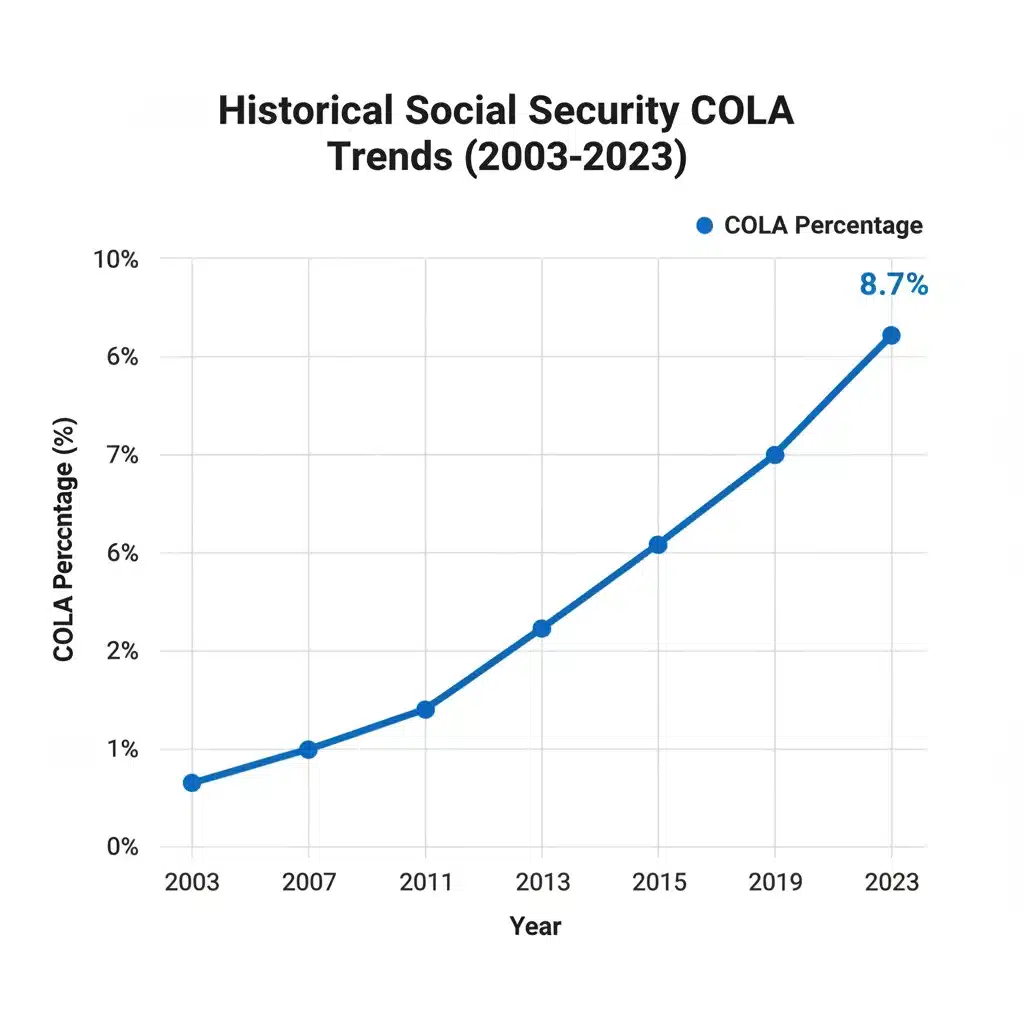
These historical trends underscore the dynamic nature of COLA. It is not a guaranteed increase but rather a responsive mechanism to economic conditions. Understanding this variability is crucial for long-term financial planning. A significant 2026 Social Security COLA could offer considerable relief, while a modest one might necessitate adjustments in personal budgets.
Recent COLA Examples:
- 2022 COLA: 5.9% (Due to significant inflation post-pandemic)
- 2023 COLA: 8.7% (The largest increase in decades, reflecting continued high inflation)
- 2024 COLA: 3.2% (Inflation moderated, but still provided a solid increase)
- 2025 COLA (projected): Varies, but current projections suggest a further moderation.
These figures demonstrate how quickly economic conditions can influence the COLA. The trajectory of inflation in 2025 will be the primary driver for the 2026 Social Security COLA. Keeping an eye on economic reports and forecasts will be beneficial.
Potential Impact of the 2026 Social Security COLA on Your Benefits
The 2026 Social Security COLA will directly affect the monthly benefit amount received by millions of Americans. Here’s a breakdown of how it might impact different groups:
For Retirees:
Retirees, especially those on a fixed income, are particularly sensitive to COLA changes. A higher COLA means more money to cover daily expenses, healthcare premiums (which often rise), and discretionary spending. A lower COLA, or no COLA, could put a strain on budgets, potentially forcing retirees to dip into savings more frequently or cut back on expenses.
The average retiree benefit will increase by the COLA percentage. For example, if the average benefit is $1,900 and the 2026 Social Security COLA is 3%, the average benefit would increase by $57 per month. While this might seem modest, it adds up over a year and helps maintain purchasing power.
For Individuals with Disabilities:
Social Security Disability Insurance (SSDI) beneficiaries also receive COLA adjustments. For those who are unable to work, these benefits are a lifeline. The 2026 Social Security COLA will help ensure that their benefits keep pace with the cost of living, covering essential needs like housing, food, and medical care.
For Survivors:
Survivor benefits, paid to widows, widowers, and children of deceased workers, are also subject to COLA. These adjustments are critical for families who have lost a primary earner, providing financial stability and ensuring that the support continues to be adequate over time. The 2026 Social Security COLA will directly influence the financial security of these vulnerable populations.
Impact on Medicare Premiums:
It’s also important to consider the ‘hold harmless’ provision. This provision prevents Medicare Part B premiums from increasing more than a beneficiary’s Social Security COLA, protecting many from a net decrease in their Social Security check. However, this protection doesn’t apply to all beneficiaries, such as those new to Medicare or those whose Part B premiums are paid by Medicaid. The interaction between the 2026 Social Security COLA and future Medicare premium adjustments will be a key consideration for many.
Forecasting the 2026 Social Security COLA: What the Experts Say
Predicting the exact 2026 Social Security COLA at this stage is challenging, as it depends heavily on inflation data that will be collected throughout 2025. However, economists and financial analysts often provide early projections based on current economic trends and models.
As of now, many initial forecasts for the 2026 COLA suggest a more moderate increase compared to the high adjustments seen in 2022 and 2023. This is largely due to the expectation that inflation will continue to cool down from its recent peaks. However, geopolitical events, supply chain disruptions, and domestic economic policies can quickly alter these projections.
Key economic indicators to watch for insights into the 2026 Social Security COLA include:
- Consumer Price Index (CPI) reports: Particularly the CPI-W, released monthly by the Bureau of Labor Statistics.
- Energy prices: Fluctuations in oil and gas prices directly impact transportation and utility costs, major components of the CPI-W.
- Food prices: A significant and often volatile component of household budgets.
- Wage growth: While not a direct input to COLA, strong wage growth can indicate inflationary pressures.
- Federal Reserve policies: Interest rate decisions by the Federal Reserve aim to control inflation, which indirectly influences the COLA.
Financial institutions and independent economic research firms will begin releasing more concrete 2026 Social Security COLA predictions as 2025 progresses and more data becomes available, especially after the second quarter of 2025.
Strategies for Preparing for the 2026 Social Security COLA
Regardless of whether the 2026 Social Security COLA is high or low, proactive financial planning is essential. Here are some strategies to help you prepare:
1. Monitor Economic Trends:
Stay informed about inflation rates and economic forecasts. Following news from the Federal Reserve, the Bureau of Labor Statistics, and reputable financial news outlets can give you an early indication of potential COLA changes. Understanding these trends can help you anticipate how your benefits might adjust.
2. Review Your Budget Regularly:
Periodically review your income and expenses. If you anticipate a lower COLA, you might need to identify areas where you can cut back on spending. If a higher COLA is expected, you can plan how to best utilize the increased funds, perhaps for savings, debt reduction, or essential purchases.
3. Diversify Income Streams:
Relying solely on Social Security can be risky, especially during periods of low COLA. Consider other income sources, such as part-time work, investments, or pensions, to supplement your Social Security benefits. This diversification can provide a buffer against modest COLA increases.
4. Optimize Healthcare Costs:
Healthcare costs are a major concern for many seniors. Research Medicare Advantage plans, prescription drug plans, and Medigap policies to ensure you have the most cost-effective coverage. Understanding how Medicare premiums interact with your COLA is also crucial.
5. Consult a Financial Advisor:
A financial advisor can provide personalized guidance on how the 2026 Social Security COLA and other economic factors might affect your overall financial plan. They can help you develop strategies for managing your retirement income, investments, and expenses.
6. Understand Your Social Security Statement:
Regularly review your Social Security statement, which provides an estimate of your future benefits based on your earnings record. This helps you understand your baseline benefit before any COLA adjustments are applied.

By taking these proactive steps, you can better position yourself to adapt to whatever the 2026 Social Security COLA brings and maintain your financial security.
The Broader Economic Picture and Future COLA Challenges
The 2026 Social Security COLA, like all future adjustments, will be influenced by a complex interplay of global and domestic economic factors. Beyond immediate inflation, long-term trends present both opportunities and challenges for Social Security’s financial health and future COLA. These include demographic shifts, such as an aging population and declining birth rates, which put pressure on the worker-to-beneficiary ratio. Additionally, ongoing debates about the solvency of Social Security and potential reforms could indirectly affect how COLA is calculated or applied in the distant future, though the current calculation method is enshrined in law.
Technological advancements and shifts in the global supply chain also play a role in inflation dynamics. For instance, automation can reduce production costs, potentially dampening inflation, while global events can create supply shocks that drive prices up. Understanding these broader forces is essential for a holistic view of the 2026 Social Security COLA and beyond.
Furthermore, the political landscape can influence economic policy, which in turn affects inflation. Government spending, taxation, and regulatory policies all have an impact on the cost of goods and services, and thus on the CPI-W. While the COLA calculation is automatic, the economic environment it responds to is shaped by these broader decisions.
For beneficiaries, this means that staying informed isn’t just about the numbers; it’s about understanding the underlying economic and political currents that shape their financial future. The 2026 Social Security COLA is a snapshot of these forces at play, reflecting the economic realities of the time.
Conclusion: Staying Informed and Prepared for the 2026 Social Security COLA
The 2026 Social Security COLA is a critical adjustment that will impact the financial well-being of millions of Americans. While the exact percentage will not be known until late 2025, understanding the calculation methodology, historical trends, and potential economic drivers allows for proactive planning.
By monitoring inflation data, reviewing your budget, and considering diverse income streams, you can better prepare for any changes to your benefits. Social Security is a cornerstone of financial security for many, and ensuring its purchasing power through COLA is vital. Staying informed and taking a proactive approach to your financial planning will empower you to navigate the adjustments of the 2026 Social Security COLA and secure your future.
Remember, the goal is not just to react to the COLA but to anticipate and plan for it, integrating these adjustments into a broader, robust financial strategy. The more informed you are about the mechanics and implications of the 2026 Social Security COLA, the better equipped you will be to protect and optimize your retirement, disability, or survivor benefits.
